BizAQ
AI-assisted search, research, and analysis for finding a small business to buy: from 373 listings across six states down to one-page briefs on the few worth a visit.
Tech Stack
Tags
Key Outcomes
- Searched business marketplaces, brokers, and public records across six states, capturing 373 listings and 19 off-market leads
- Advanced 6 businesses to full analysis, including site visits and seller negotiations
- Researched each market with demographics, traffic counts, nearby competitors, gaming revenue, and license and ownership records
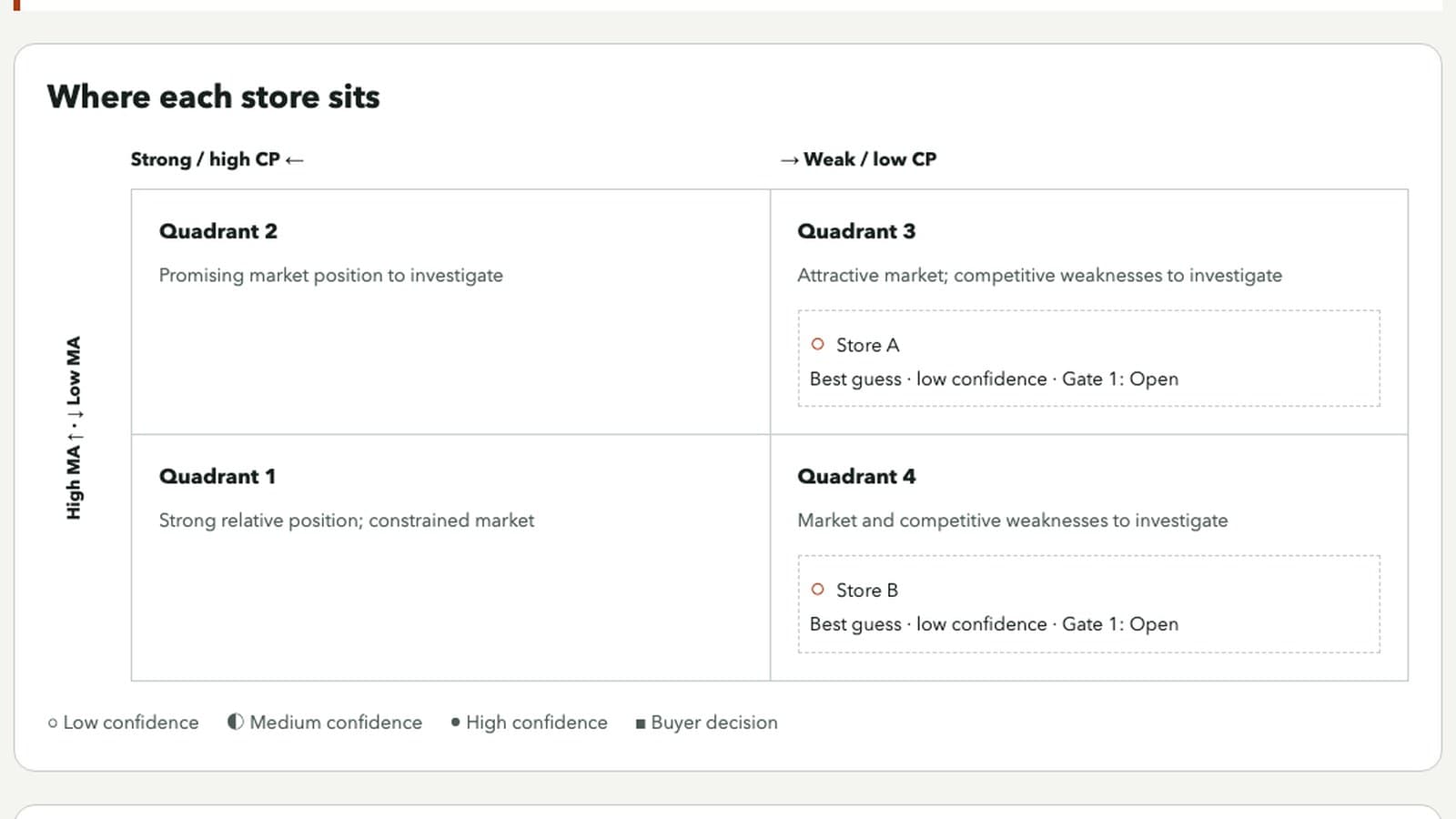
- Placed every store on a market-attractiveness vs. competitive-position grid, each linked to a one-page brief
- Built guardrails for AI-written analysis, backed by 310 tests: claims must cite dated evidence and cannot be more confident than that evidence allows
Overview
I built BizAQ to support my own search for a small business to acquire, starting with gas stations and convenience stores. It covers the whole funnel: finding businesses for sale, researching each one's market, and analyzing whether a deal makes sense.
AI agents do most of the searching and research. I make every decision and handle every conversation with sellers.
Search
- On-market: agents sweep a fixed list of business marketplaces and brokers, including BizBuySell, BizQuest, LoopNet, and regional brokers, across six states. So far that has captured 373 listings.
- Off-market: town-by-town store lists built from public data, plus state liquor-license records grouped into owners who run several locations. That produced 19 off-market leads.
- Coverage checks: I give the agents listings I already know about, and each sweep reports whether it found them. A miss means the search is incomplete, and the report says so.
Research
For each business worth a closer look, the research covers:
- Demographics from the Census American Community Survey, plus business counts from County Business Patterns.
- Traffic counts from the state transportation department.
- Nearby competitors from OpenStreetMap, checked during site visits.
- Gaming revenue from state gaming board reports, for stores with video gaming terminals.
- License and ownership records, including who holds the liquor license and who owns the land.
Every fact carries its source and the date it was retrieved. Public data is saved as checksum-verified snapshots, so any report can be traced back to exactly what it used.
Analysis
Each business gets a market assessment across 13 factors, placed on two separate axes:
- Market attractiveness: demand, trends, nearby trip generators, road access, and alternatives.
- Competitive position: visibility and access, reliability, offer, hours, and prices, competitors, and current customer patterns.
The grid above places every researched store on those two axes, with a confidence level for each placement. Each store links to a one-page brief that answers five questions in order: Can I afford it? Is it legal? What big costs are coming? How is the market? What's next?
Behind the brief, unit-economics tools calculate monthly profit and loss, break-even, cash needed to open, and payback time.
The grid is deliberately not a ranking. There is no overall score or automatic winner; it shows where the evidence is strong or thin so I can decide what to check next.
Guardrails for AI-Written Analysis
AI agents are good at gathering information and bad at knowing what they don't know. BizAQ treats every agent-written assessment as untrusted input:
- Each claim must cite evidence, and assessments must also list contrary evidence and missing facts.
- The validator works out the highest confidence the cited evidence supports, and rejects any assessment that claims more.
- Published assessments are immutable snapshots. A changed assessment gets a new ID instead of overwriting history.
- Invalid input never replaces the last good report, and file paths are checked before anything is written.
The Python pipeline behind all of this has 310 tests.
Human in Control
BizAQ has no email, phone, or messaging integration. Agents can research public sources and prepare drafts, but only I contact sellers, brokers, or owners. My decisions live in separate files that agents can read but never change.
What's Next
I'm splitting the pipeline into an orchestrator and sub-agents for search, research, and analysis. Each sub-agent will write to the same validated contracts, so every handoff is checked before the next stage runs.